


What You Need to Know About Patio Fountains?
Most patios are finished before anyone starts shopping. The table sits where it sits, the chairs went in a few summers ago, and there's one corner by the fence that has stayed empty because nothing has ever fit it.
People shopping patio fountains have usually settled the floor plan already. They know roughly where the piece goes, and what they're weighing is whether something in cast stone, heavy enough to arrive on a pallet and stay where it lands, belongs in a space they walk through every day. It's a considered purchase and rarely a quick one.
Three shapes account for most of what's here, and what separates them is floor.
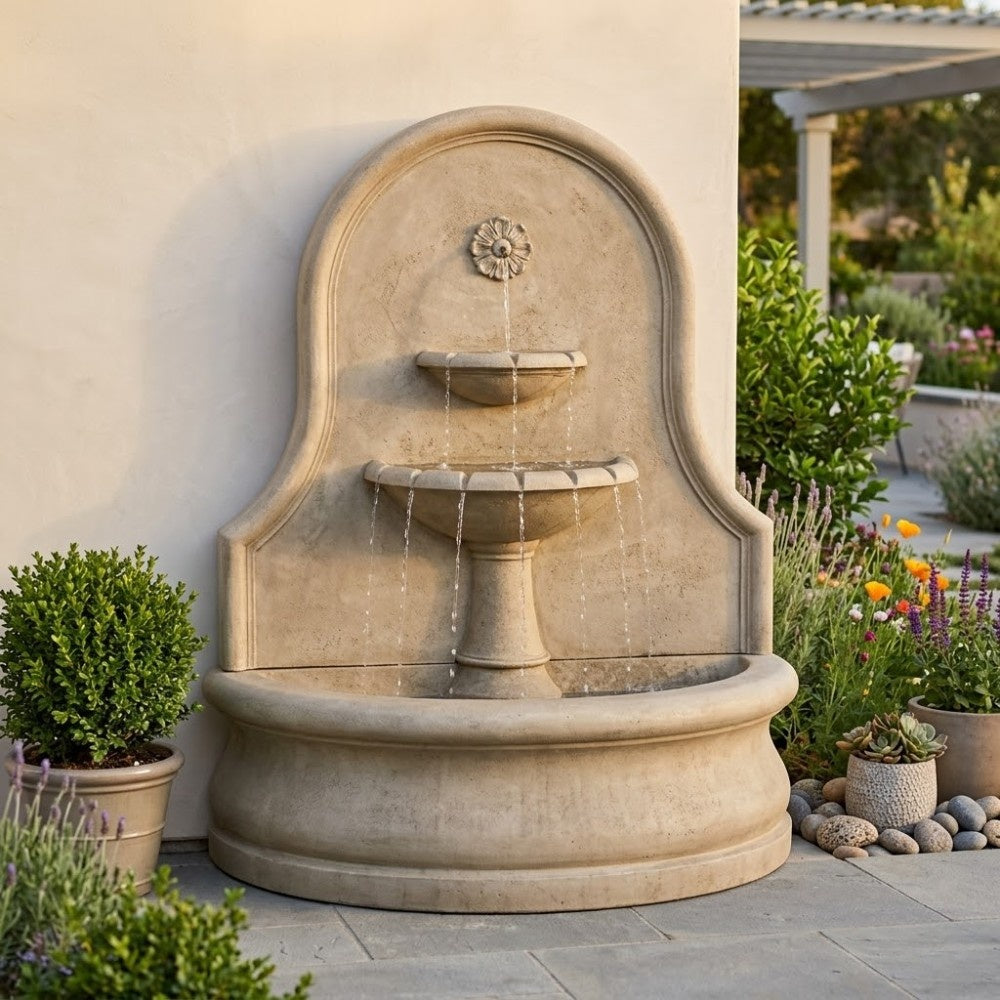
Tiered pieces stack basin on basin, so the water falls in short steps rather than one long drop. In a plain finish they still read formal, and on a patio they become what you look at from the kitchen window rather than something you sit beside. Most people arrive at the stacked, multi-tier fountain designs once the corner turns out bigger than they'd assumed. Centered in a seating area one reads as an obstacle; at an edge, deliberate.
Patio wall fountains hang flat against a wall or railing, giving up almost no floor. Anyone out of floor ends up looking at pieces built to hang against a wall. Sound is the surprise. Fencing and house walls hold water noise close instead of letting it thin out, so a piece that seems quiet across a yard sits louder here.
Some patios are only the paved end of a planted area, and the fountain has to belong to both. That's the case for widening the search to fountains drawn for a garden setting, where pieces are shaped for soft ground and open sightlines rather than a fixed rectangle. Proximity is the trade. Water a few steps from the table gets noticed the day it turns cloudy.
Outdoor patio fountains get compared on height, because height is what a photograph shows. Width is what you live with. A tall, narrow piece can stand against the fence and half disappear into it, while something shorter on a wide basin turns the walk from table to door into a detour. That isn't an argument for going small. Buyers shrink the choice fearing they'll overwhelm the space, and on a patio with room, that's the costlier mistake.
Not everything sorts. Birdbath-style basins are the clearest case: shallow and open, they bring birds onto the patio, which is the point for some buyers and more debris in the water for everyone else. Splash resists the categories too. Water leaves the basin on well-made fountains, so the surface underneath wants to be stone or sealed paver.
What this collection is for is a surface whose dimensions stopped being negotiable a long time ago. The floor decides. Everything after that is taste.
FAQs
Common Questions About Patio Fountains
Thirty inches of walking clearance is the floor on a tight patio, and 36 to 48 inches is comfortable. Basin width is the other half of it, running to roughly a third of the width of the space it sits in, so a patio 12 feet across suits a basin close to 4 feet. That ratio isn't a technical limit. It matches how people read a space.
Judge it against whatever sits behind it rather than on its own, aiming for roughly halfway up that backdrop. Open planting behind suits 24 to 36 inches, a hedge or fence 36 to 48, and a house wall 48 to 72. Viewing distance pushes the same way: 6 to 10 feet away suits 24 to 36 inches, 10 to 18 feet suits 36 to 48, and anything further back wants 48 to 72.
No. Sound comes from drop height and flow rate, not overall size. A tall piece with short falls between levels can run quieter than something half its height dropping water further. Which is why sizing down out of noise worry tends to backfire, leaving the buyer with a smaller fountain and the same sound.
On a patio, it can be. Walls, fencing and railings don't give sound anywhere to go, so it stays around you rather than thinning out across a yard, and the same piece can be pleasant at the far end of a garden and intrusive beside a dining table. Start the flow low. Turning it up later is easy; the reverse is where people get stuck.
Off-center, and out of the walking lanes. A fountain in the middle of a seating area reads as an obstacle even when the clearance measurements say it fits, while the same piece at an edge, visible but out of the way, reads as intentional. Placements that tend to work: at the end of a path, behind a bench or bistro set, or where it's the first thing you see stepping outside
Cut cardboard to the basin's widest measurement, tape it down where the fountain would sit, and live with it for a day. Walk past it, sit next to it, look at it from indoors. It prevents more returns than any measurement chart, and it earns the effort because most of these are cast stone, arrive on a freight pallet, and run to a few hundred pounds. Exchanging one is a project.
Weekly you check the water level and lift out debris, since a low basin makes the pump pull air instead of water. Monthly you unplug the pump, drain it and wipe the interior, which on smaller pieces runs under 15 minutes. Once a year it gets a full reset. A patio doesn't lengthen that list. It just puts you close enough to notice cloudy water the day it turns.
It does. Water leaves the basin on well-made fountains, not only badly made ones, so what's underneath wants to be stone or properly sealed paver. A slight grade or a drainage gap keeps water from pooling at the base. Setting the piece within a defined paver area also gives you a level base, which is what the water needs to move the way the fountain was designed to move it.
Depends on the climate. Where it drops below freezing, water left in a basin can freeze, expand and damage the material, so the fountain gets drained and the pump comes indoors; smaller pieces often move inside whole. Somewhere it never freezes, the annual deep clean takes the place of winterizing.